What to Check Before You Call When Your AC Quits on a 100-Degree Afternoon
A handful of five-minute checks that either fix the problem or tell you exactly what to say when you pick up the phone.
August 27, 2026 · 4 min read
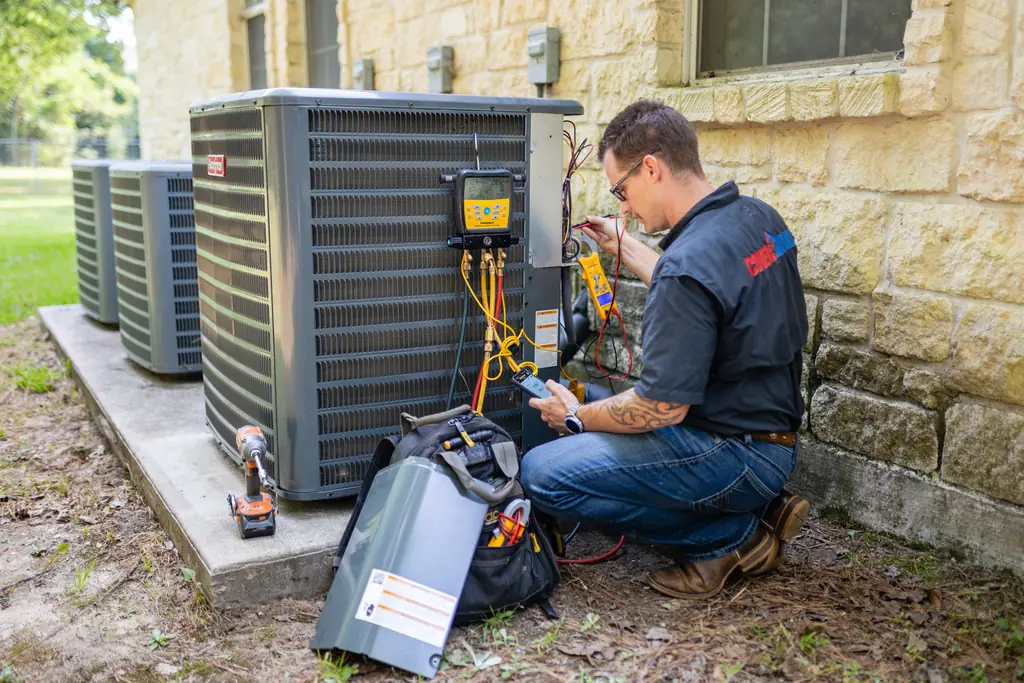
It is always the same afternoon. The temperature outside is somewhere past ninety-eight, the house has been holding steady all week, and then the vents go quiet. Before you assume the worst, there are a few things worth ten minutes of your time. Most of them do not require a ladder, a meter, or any tools at all, and any one of them can turn a service call into a five-minute fix.
Start at the thermostat
Look at the display before anything else. If it is blank, the system may simply have lost power at a different point than you think, which rules out a refrigerant or compressor problem entirely and points you toward a breaker or a battery. If it is lit but the fan will not switch on when you set it to Cool with the temperature dropped a few degrees below room temperature, note that too. A thermostat that responds but does not call for cooling is a different problem than one that is dark.
Walk to the breaker panel
Central air conditioning almost always runs on two separate breakers: one for the indoor air handler and one for the outdoor condenser. A tripped breaker on one side and not the other will still let the fan blow, just without any cooling behind it, which is a common source of confusion. Reset a tripped breaker once. If it trips again immediately, stop there and do not keep resetting it. A breaker that will not hold is telling you something drew too much current, and forcing it back on repeatedly is how a small electrical fault becomes an expensive one.
Check the air handler closet
Pull the filter and hold it up to a light. If you cannot see light through it, that alone can be enough to shut a system down. A clogged filter starves the indoor coil of airflow, the coil drops below freezing, ice builds on it, and the system either stops cooling or trips out on a safety switch entirely. While you are there, look at the drain pan underneath the air handler. Standing water is a sign the condensate line is blocked, and many systems are wired with a float switch that shuts the whole unit off the moment that pan fills, specifically to stop water from reaching the ceiling below. That switch doing its job looks, from the thermostat, exactly like a dead system.
Look at the outdoor unit
Walk outside and listen. A unit that hums but the fan on top does not turn is a different fault than total silence, and it is worth mentioning exactly that when you call, because it points a technician toward the electrical side of the condenser rather than the compressor itself. Check that nothing is physically blocking the unit: a fallen branch, a stack of yard debris, or grass clippings packed into the fins can restrict airflow enough to trip the system on high pressure. Do not open the panel or touch anything inside the cabinet. High-voltage capacitors inside a condenser can hold a charge even with the power off.
- Thermostat: lit or blank, and does the fan respond to a lower setpoint
- Breaker panel: both the air handler and condenser breakers, reset once only
- Filter: held up to a light, replaced if you cannot see through it
- Drain pan: dry or standing water under the air handler
- Outdoor unit: humming or silent, and anything physically blocking it
Keeping the house bearable while you wait
If the checks above did not bring the system back and you are waiting on a call, close the blinds on any window that gets direct afternoon sun. A surprising amount of heat gain in a Texas house comes straight through south and west-facing glass, and blocking it does more than people expect for the hour or two before help arrives. Run ceiling fans in the rooms you are actually using. Moving air makes a room feel several degrees cooler than the same air sitting still, even with no cooling behind it. Hold off on the oven and the dryer if you can, since both add real heat and humidity to a house that already has too much of both. None of this fixes the system, but it buys comfort while you wait.
When to stop and call
If none of that gets air moving again, or if a breaker will not hold, that is the point to stop troubleshooting. The AC repair page on this site walks through the specific symptoms that usually separate an airflow problem from an electrical one from a refrigerant one, which is useful reading before the call even if you never open a panel yourself. Cover HVAC has been working on residential systems across Montgomery County and the Brazos Valley since 2018, and the crew is reachable at (281) 378-5778 Monday through Saturday, seven in the morning to seven at night. Telling the technician which of the checks above you already ran saves time on both ends, because it rules out the obvious before the truck even leaves the shop, and a system that has been off for a while due to a tripped breaker is worth mentioning too, since restarting after a long outage can behave differently than a normal cycle.
Cover HVAC, (281) 378-5778
Call (281) 378-5778More articles
Why Your Attic Ductwork Decides How Every Room Actually Feels
The condenser in the yard gets blamed for problems that usually start with the ducts nobody ever sees.
What a Maintenance Visit Actually Covers, and Why the Timing Matters
The value of a maintenance visit has less to do with how often it happens and more to do with when.