Why Your Attic Ductwork Decides How Every Room Actually Feels
The condenser in the yard gets blamed for problems that usually start with the ducts nobody ever sees.
August 27, 2026 · 4 min read
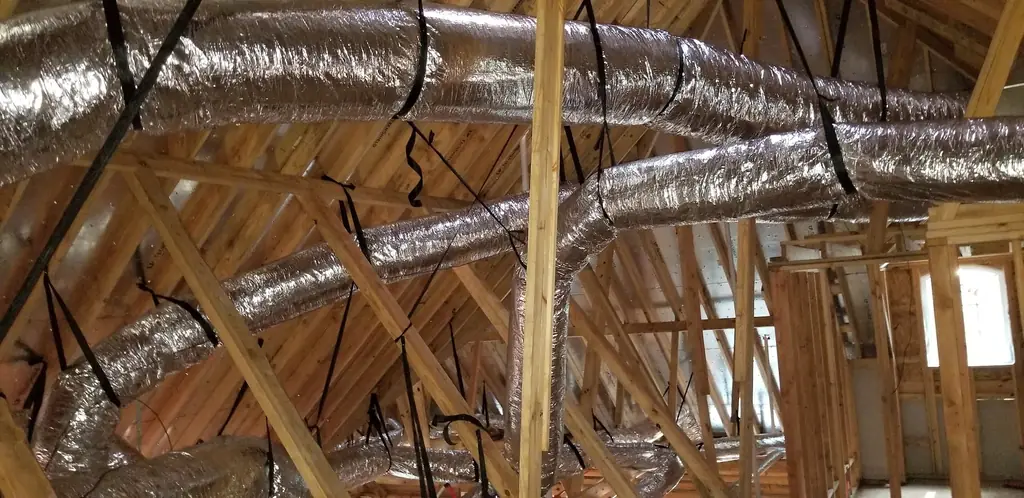
Ask most homeowners what cools their house and they will point at the box in the side yard. That box matters, but it can only push air as well as the ductwork lets it. In a lot of Texas houses, especially ones built in phases or added onto over the years, the ducts in the attic are doing more damage to comfort than any single piece of equipment ever could.
What the ducts are actually doing
A central system moves a fixed volume of air through a network of insulated flexible or rigid trunk lines, branching off to each room's supply register, with a separate set of return ducts pulling air back to the air handler to be cooled again. Every foot of that path has resistance, called static pressure. A duct that is too small for the room it feeds, crushed under insulation, kinked around a truss, or simply too long for the air to make it there at full force will starve that one room no matter how well the equipment outside is running. This is why the bedroom at the end of the hall is always five degrees warmer than the living room, even on a system that is otherwise working exactly as designed.
Leaks cost more than people expect
A duct system does not have to be crushed to lose performance. Loose connections at the joints, tape that has dried out and let go, or a branch line that was never sealed properly will leak conditioned air straight into a hundred-and-thirty-degree attic before it ever reaches a room. That is air you already paid to cool, dumped above the ceiling instead of coming out of a vent. It also pulls attic air the other direction into the return side, which is hot, dusty, and not what anyone wants circulating through the house.
New construction is not automatically right
It is a common assumption that duct problems only happen in older houses, but a new build can have the exact same issues if the trunk and branch runs were sized off a generic layout rather than the actual rooms and their exposure. A room with a west-facing wall and a wall of windows needs more airflow than a similar-sized interior room, and duct design that does not account for that will leave one comfortable and one not, on the very first summer the house is occupied.
The return side is half the system too
Most of the attention goes to supply ducts, the ones carrying cooled air out to each room, but the return side matters just as much and gets thought about far less. A house with too few return grilles, or returns that are undersized for the volume of air the system needs to pull back, ends up pressurized in a way that fights the whole system. Air struggles to get back to the air handler, which makes the blower work harder for less result, and it can pull outside air in through gaps around windows and doors instead, dragging in attic heat and humidity right along with it. A single central return in a large house is a common shortcut that shows up later as uneven comfort nobody can quite explain.
Attic heat makes every duct problem worse
A Texas attic can sit well above one hundred and thirty degrees on a summer afternoon, which means the ductwork running through it is surrounded by heat on all sides no matter how well the house itself is insulated. Insulation wrapped around the duct slows that heat transfer but does not stop it, and any gap in that wrapping, any spot where the insulation has slipped or was never sealed tight, becomes a point where the air inside the duct picks up heat before it ever reaches the room it was meant to cool. This is part of why a duct system that looked fine ten years ago can quietly lose performance over time, as insulation settles and seams loosen, without anyone doing anything wrong.
- One room consistently warmer or cooler than the rest of the house
- Rooms far from the air handler that never quite catch up
- A system that runs constantly but the house still feels uneven
- Visible gaps, disconnected sections, or crushed flex duct in the attic
- Noticeably higher summer bills than a similar-sized neighboring house
Why this gets fixed during a replacement, not after
The best time to correct duct problems is during an equipment replacement, while the attic is already open and a crew is already up there. On at least one job, rerouting part of the duct work while replacing the equipment was done purely so the attic could be reached more easily on the next visit, which is the kind of small decision that pays off years later. The AC installation page covers what a proper installation actually involves beyond just swapping the outdoor unit. Cover HVAC has served Magnolia, Plantersville and the rest of Montgomery County, along with College Station, Bryan, Navasota and Brenham in the Brazos Valley, since 2018, and a straight answer about what is actually happening above your ceiling is one call away at (281) 378-5778.
Cover HVAC, (281) 378-5778
Call (281) 378-5778More articles
What to Check Before You Call When Your AC Quits on a 100-Degree Afternoon
A handful of five-minute checks that either fix the problem or tell you exactly what to say when you pick up the phone.
What a Maintenance Visit Actually Covers, and Why the Timing Matters
The value of a maintenance visit has less to do with how often it happens and more to do with when.