The Small Part That Takes Down a Whole AC: Run Capacitors Explained
A part smaller than a soup can is one of the most common reasons a whole air conditioner refuses to start.
August 27, 2026 · 3 min read
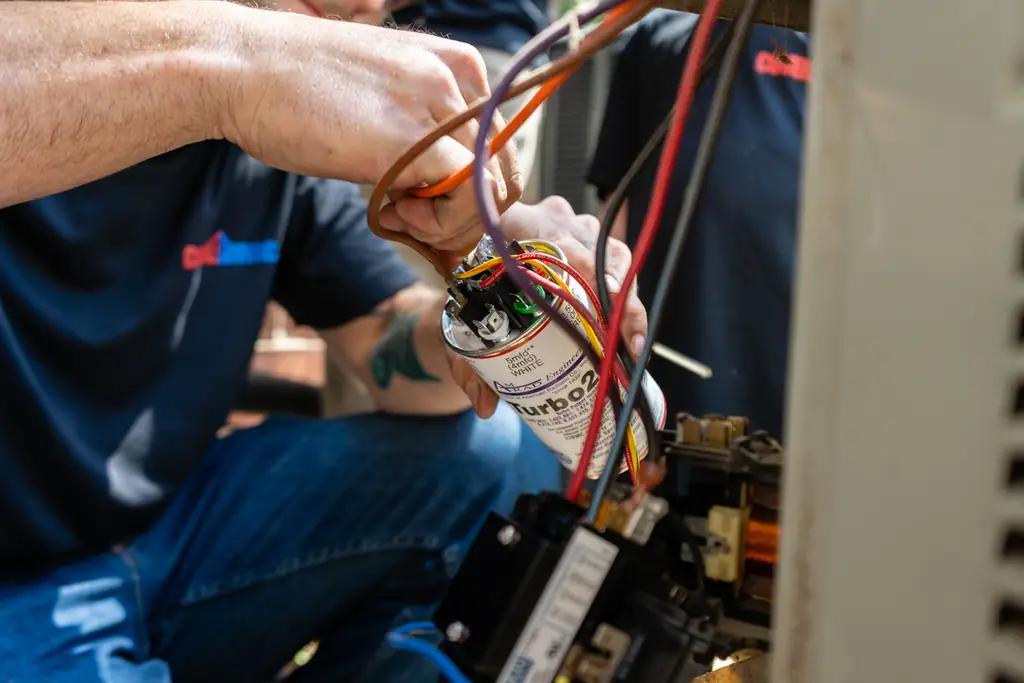
If a technician opens a condenser cabinet for a no-start call, the run capacitor is usually one of the first things checked, and for good reason. It is a small cylindrical part, often no bigger than a soup can, and it is responsible for giving both the compressor and the outdoor fan motor the extra electrical push they need to actually start turning. When it fails, the symptoms can look dramatic even though the fix itself is straightforward.
What a capacitor actually does
An AC compressor and fan motor cannot get themselves moving from a dead stop on ordinary household current alone. The capacitor stores a charge and releases it in a burst at the moment the motor is asked to start, providing the extra torque needed to get a heavy compressor or fan blade spinning. Once the motor is running, a second section of the same capacitor keeps giving it a steady boost to run efficiently. Most residential systems use what is called a dual run capacitor, which does both jobs, for both the compressor and the fan motor, inside a single part.
Why they fail
Capacitors are rated for a certain voltage and a certain capacitance, measured in microfarads, and both of those numbers drift as the part ages. Heat is the main enemy. A capacitor sitting inside a condenser cabinet in a Texas summer, cycling on and off dozens of times a day for years, gradually loses its ability to hold a charge. Power surges accelerate the same wear. Eventually the capacitor's readings fall outside the tolerance the motor needs, and the motor either struggles to start, runs but strains, or does not start at all.
What the symptoms actually look like
A failing capacitor rarely gives one clean signal. Sometimes the outdoor fan is running but the compressor is silently not, which sounds like the system is working from indoors even though nothing is actually cooling. Sometimes there is a distinct humming sound from the condenser with nothing visibly moving, which is the motor trying and failing to start. A slight physical bulge on the top of the capacitor's casing, visible without removing it, is a reliable sign it has already failed or is about to. None of these symptoms tell you for certain it is the capacitor without a meter, which is exactly why this is not a part to diagnose by guesswork.
- Outdoor fan running with no cooling coming from the compressor
- A humming sound from the condenser with nothing turning
- The system trying to start, clicking, then going quiet
- A visible bulge on top of the capacitor housing
- A system that starts fine on some days and not on hot afternoons
How a technician actually confirms it
A capacitance meter reads the part's actual microfarad rating and compares it against the number printed on the capacitor's own casing. Manufacturers build in some tolerance, usually a small percentage above or below the rated figure, and a reading that has drifted outside that range is a clear, measurable failure rather than a guess. Because a dual run capacitor handles both the compressor and the fan motor from the same part, a technician checks both sections separately. It is entirely possible for one side to have failed while the other still reads within range, which is part of why a visual bulge alone is not always the full story, and why a meter reading is worth more than a look.
Why this is not a weekend project
A run capacitor can hold a dangerous electrical charge even with the unit's power switched off, which is exactly why the checklist on this site's own troubleshooting advice always stops short of opening the condenser cabinet yourself. Replacing one takes a technician a matter of minutes with the right part and a meter to confirm the reading, but confirming it is actually the capacitor, and not a failing motor being masked by a bad capacitor reading, is the part that takes real diagnostic experience. A motor that is failing on its own can sometimes cause a capacitor to read poorly too, and swapping the capacitor without checking the motor's own amperage draw can mean a customer pays for a part twice, once for the capacitor and once for the motor it did not fix. The AC repair page covers the broader set of symptoms Cover HVAC's technicians ask about on every call. Reach the crew at (281) 378-5778, Monday through Saturday, seven to seven, across Montgomery County and the Brazos Valley.
Cover HVAC, (281) 378-5778
Call (281) 378-5778More articles
What to Check Before You Call When Your AC Quits on a 100-Degree Afternoon
A handful of five-minute checks that either fix the problem or tell you exactly what to say when you pick up the phone.
Why Your Attic Ductwork Decides How Every Room Actually Feels
The condenser in the yard gets blamed for problems that usually start with the ducts nobody ever sees.